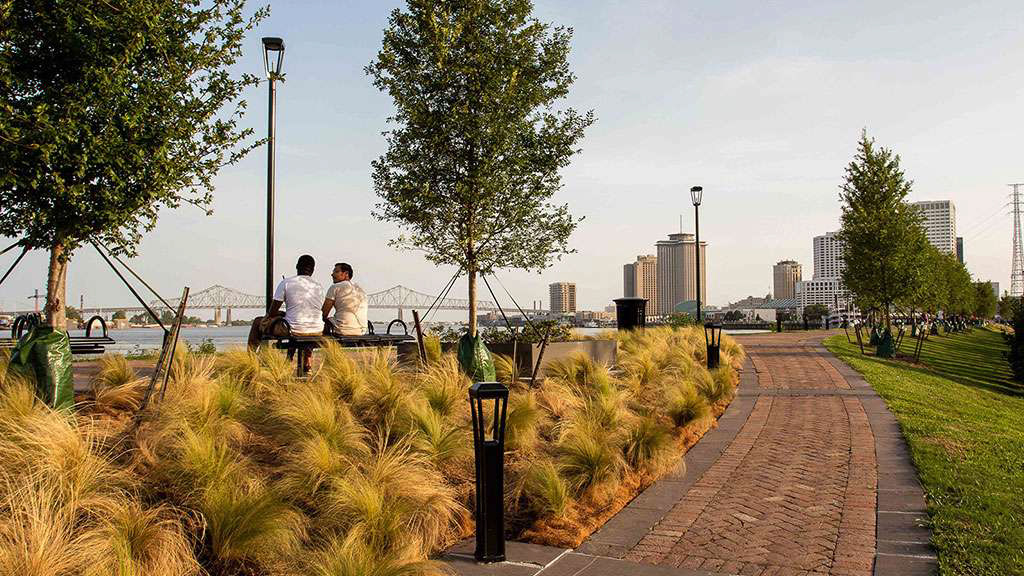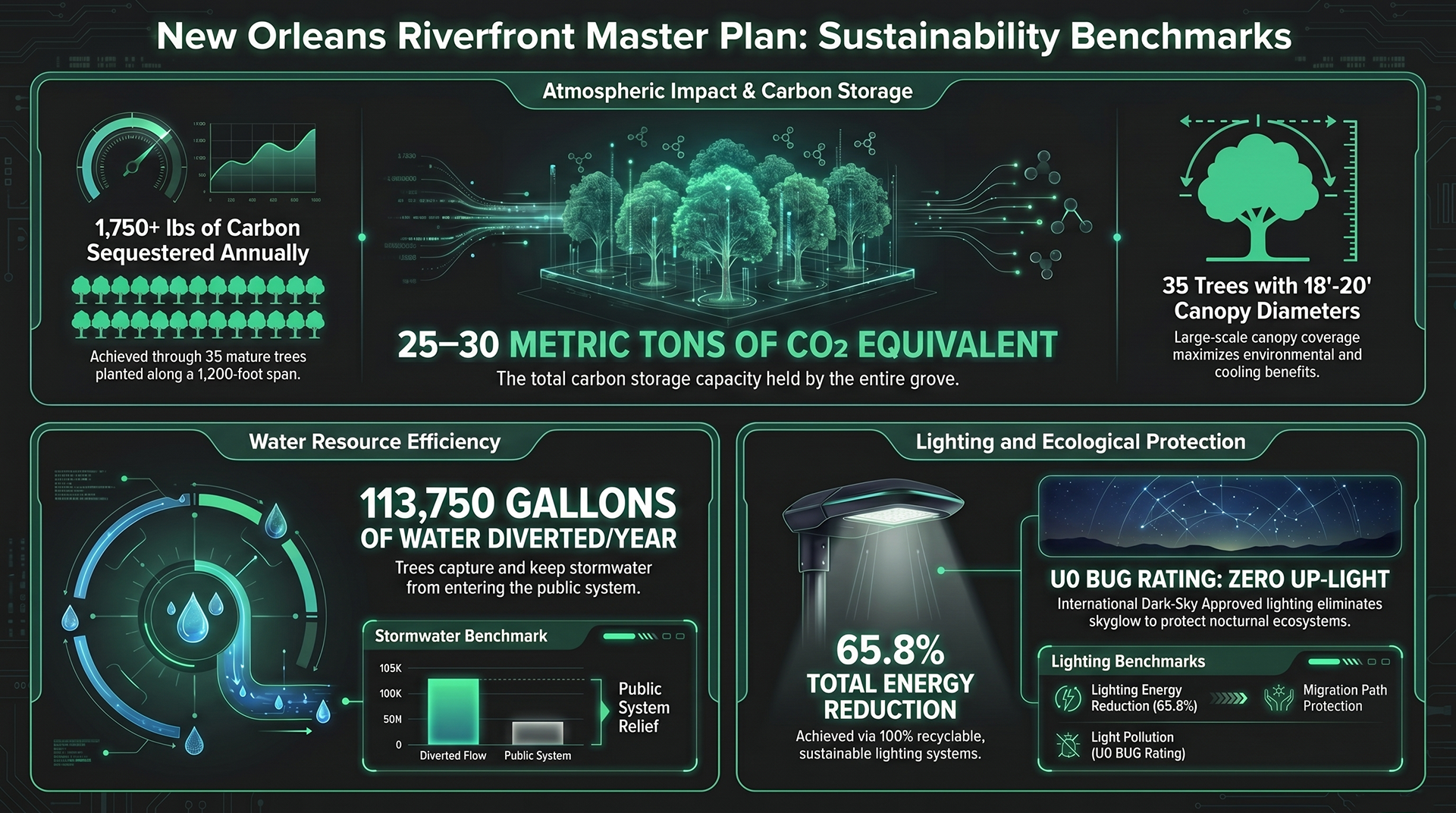
Statistics from the Moon Walk implementation.
For decades, the US Army Corps of Engineers (USACE) maintained a strict ban on planting trees along earthen levees, citing concerns over root penetration and structural failure. This policy effectively condemned the Moon Walk—one of the city’s most iconic pedestrian spaces—to be an unshaded "heat island," stripping the riverfront of its potential for nature-based designs.
The Challenge: Reconciling Federal Security with Urban Vitality
The New Orleans Riverfront is one of the most high-stakes infrastructure corridors in the world, sitting at the intersection of a $29.8 billion economic engine (The Port of New Orleans) and critical federal flood protection systems. For decades, a 'no-vegetation' mandate from the US Army Corps of Engineers (USACE) created a stalemate, preventing the deployment of nature-based solutions on earthen levees. This policy-driven friction left iconic spaces like the 'Moon Walk' as unshaded heat islands, detached from modern sustainability performance.
Data-Driven Policy Innovation
I led a technical 'deep-dive' into federal engineering documentation to challenge the status quo. By synthesizing obscure USACE technical memos with modern geotechnical data, I presented evidence that specific deep-rooted species can actually increase levee stability through soil reinforcement and moisture regulation. This evidence-based advocacy resulted in a landmark federal exception, allowing for the first shade canopy on a federal flood-control structure. This win established a national precedent for integrating green infrastructure with critical security assets.
Strategic Coalition Building & Technical Buy-In
Modernizing a federal framework required more than design; it required Cross-Functional Governance. I joined a coalition between the City of New Orleans, the US Army Corps of Engineers, and the Port of New Orleans to ensure that urban design enhancements did not compromise maritime or flood-security operations. By resolving the tension between federal 'safety-first' mandates and municipal 'quality-of-life' goals, I created a Unified Implementation Framework that is now used as a roadmap for the city's 'front door' redevelopment.
National Precedent & Salutogenic Design
The implementation of the Master Plan transformed an industrial utility into a high-performance urban asset. The successful deployment of 'salutogenic' (health-promoting) design interventions has significantly mitigated the Urban Heat Island effect along the riverfront, where summer ambient temperatures can be 10°F to 20°F higher than in shaded areas. This project proves that technical rigor can be used to shift national policy and unlock the full economic and social potential of restricted infrastructure.