With 92% of Charlotte’s water basins facing significant environmental degradation, the city needed more than just high-level sustainability goals. There was a critical gap between ecological science and the technical execution of street-level infrastructure.
The Solution: A Bridge from Policy to Practice
I authored and orchestrated the Green Streets Toolkit, a cross-departmental initiative designed to operationalize complex resilience frameworks into actionable, accessible standards for municipal stormwater and public realm design. Citywide adoption of the standards in this toolkit is projected to contribute to $368M in public health benefits, $360M in energy savings, and $969M in infrastructure savings over a 35-year period.
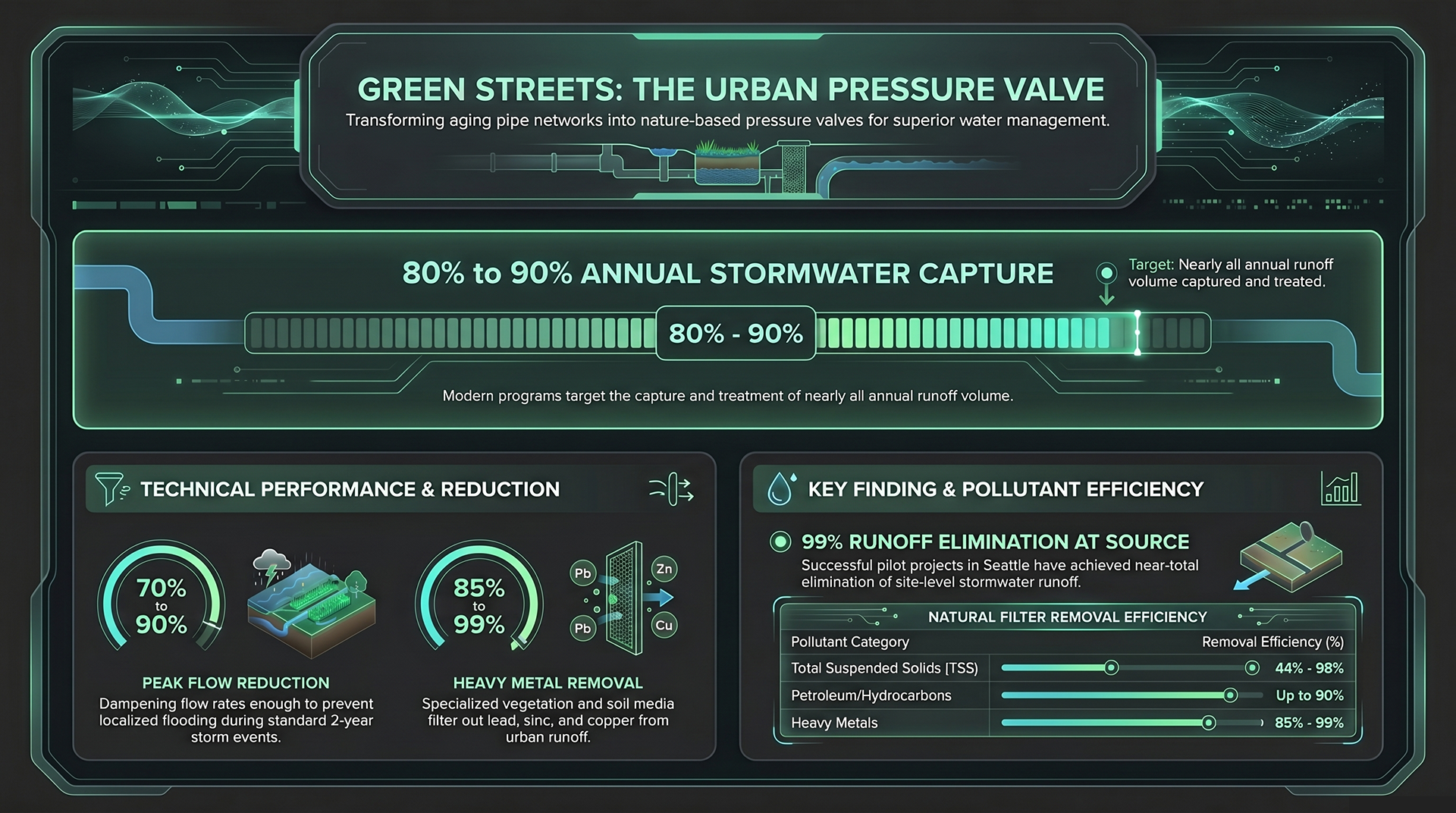
Green Streets act as "living filters," removing non-point source pollutants before they reach our watersheds. By replacing asphalt with engineered soils and native vegetation, these interventions restore local habitats and can reduce summer ambient temperatures by 10°F to 20°F, significantly mitigating the urban heat island effect. The toolkit provides the necessary resources to move projects from high-level policy to long-term performance across five key focus areas.
1. Policy and Planning
Embedded green infrastructure into the city’s regulatory landscape by aligning the toolkit with the Charlotte Future: 2040 Comprehensive Plan, Strategic Energy Action Plan Plus (SEAP+), Strategic Mobility Plan, and the Charlotte Streets Manual. This integrated approach translates high-level mandates—such as Goal 7 of the Comprehensive Plan and the Sustainable Horizontal Infrastructure Policy (SHIP)—into actionable standards that prioritize flood mitigation, tree canopy preservation, and the reduction of the urban heat island effect across all municipal projects.
2. Partnerships and Community Support
Orchestrated a participatory planning framework that prioritizes transparency and equity, particularly in underserved communities disproportionately impacted by climate change. By formalizing collaborations with the EPA Environmental Finance Centers, Smart Surfaces Coalition, and Mecklenburg Soil & Water Conservation District, I established a network of technical and educational resources to build community trust. This approach utilizes community design sessions, educational workshops, and visible pilot projects to transform green infrastructure from a municipal requirement into a shared community asset.
3. Funding and Financing
Developed a comprehensive resource that identifies and leverages diverse capital streams, including federal competitive grants like the EPA’s Section 319 and FHWA’s Transportation Alternatives Program, as well as state-level opportunities such as the NC Land and Water Fund. This strategic framework further outlines municipal financing tools like Clean Water State Revolving Fund (CWSRF) low-interest loans and Municipal Bonds, while pioneering public-private partnerships such as the GreenPrints initiative to ensure projects are financially viable from initial construction through long-term stewardship.
4. Operational Excellence & Lifecycle Management
Established a dedicated operational framework that treats green infrastructure as a long-term municipal asset. By integrating maintenance into the initial design phase, the toolkit ensures that components like soil media and permeable surfaces remain functional and cost-effective over their lifecycle. This strategy advocates for sustainable funding through stormwater utility fees and municipal assessments, paired with a recurring education and training program to equip city personnel and community volunteers with the expertise needed to preserve the environmental and economic value of every project.
5. Sustainability Standards
Developed a "Menu of Proven Details" that integrates multifunctional green infrastructure elements—such as swales, permeable pavements, and stormwater bump-outs—into established municipal frameworks. By aligning the toolkit with the Charlotte Land Development Standards Manual (CLDSM), the Charlotte Stormwater Control Measure Design Manual (CSCM), and the NACTO Urban Street Stormwater Guide, I provided city engineers and developers with a vetted, low-risk library of standardized construction details that ensure consistency, safety, and high-performance environmental functionality.
Strategic Value
This toolkit demonstrates the ability to synchronize disparate municipal goals into a unified technical standard that reduces implementation risk and ensures long-term asset performance. By translating high-level sustainability mandates into a low-risk library of vetted details, I enable cross-functional teams to deploy complex infrastructure at scale without increasing operational friction.